

We Have Met the Enemy
Medicare Fraud
Medicare Fraud is big in the news lately, as if this is some newly discovered criminal action perpetuated by a small group of immigrants in Minnesota. If only that was so. No one knows how large Medicare fraud is. It is estimated at about $60 billion a year. If you add in Medicaid and private insurance fraud, the number may be as much as 10% of America’s total spending on health care!.
Fraudulent insurance schemes involve a host of ruses including fake medical equipment orders, improper telehealth prescriptions, charges by clinics that do not exist, extra time billed for by-the-quarter-hour services, like physical therapy, and home care for non-existent patients.
The administration may be vilifying Minnesota, but the fact is this fraud takes place all over the country. The clear winner in the insurance fraud derby is Florida by a long stretch. A large part of Malcom Gladwell’s book, Revenge of the Tipping Point was dedicated to the unbelievable amount of fraud taking place just in Miami. Gladwell writes that time after time he saw “medical offices” set up with empty waiting rooms, computers not even wired or plugged in, and receptionists with no idea why they were sitting there, collecting salaries. All over the country, scammers have set up health clinics with no patients, telehealth services that ask no patient questions, and orders for wheelchairs with no users.
Medicare funds are often wasted by legitimate companies as well. Insurance companies encourage patients to order multi-month supplies of medications that are often never used. This wastes money and risks having surplus drugs sitting in the homes of seniors or flushed into the water supply. The real cost of Medicare fraud is unknown, but the total likely dwarfs many other government expenses.
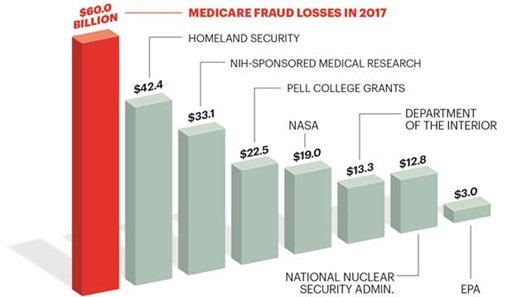
The main reasons cited behind this enormous problem is that government health systems are so complex making treatments almost impossible to verify. The US pays first and maybe asks questions maybe later, maybe not.
If Congress cared more about these tens of billions in waste, there is much that could be done. They could vet new providers more carefully, inspecting facilities to see if they even exist. End-users could be polled to see if they received costly treatment (or even exist). The program has grown too complex and large to function efficiently. Without Congressional oversight, the waste just grows and grows.
Student debt
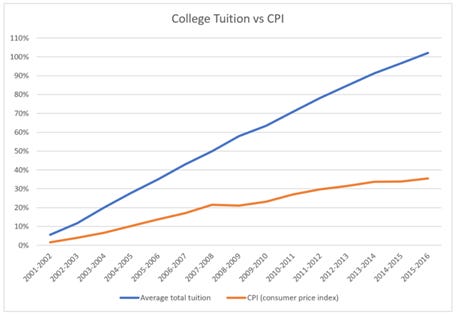
Student debt is now so large that the previous administration attempted to just wave it all away (or more accurately, transfer the debt to taxpayers). The root cause of student debt, as we explored in our April piece, The Poisoned Apple of Education, is the ease of creating the debt, thanks to lax government rules that encourage massive loans. This, in turn, causes tuition to rise (often called the Bennett Hypothesis). Private college tuition has ballooned vastly out of proportion to other consumer costs.
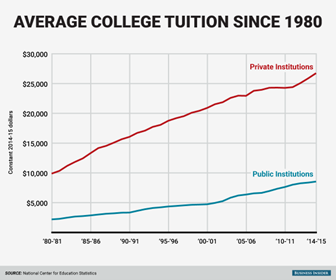
Private institutions also grew their tuition much faster than public versions.
For-profit schools happily raised prices and added programs because government-backed loans are easy to obtain. Post-graduate students are the most profitable. Therefore, Colleges disappear, transforming almost magically, into universities overnight.
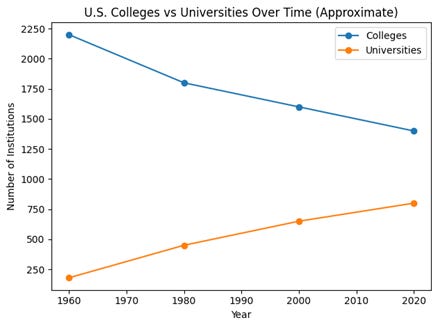
The result, armies of graduates who cannot use their degrees to make a living and are therefore unable to service the debt they signed up for. In the meantime, we have a critical shortage skilled workers needed to fill high-paying jobs as electricians, mechanics and plumbers. It is easier, and more profitable, to obtain government-backed loans for unused master’s degrees than for trade schools.
The obvious solution is to get the government (aka taxpayers) out of the student loan business. Private financial institutions are traditionally more careful with their lending practices requiring outrageous things like proof of income and a credit check whereas Federal student loans don’t generally require either of these. Tuition at private schools would need to fall to affordable levels and prospective students would consider the value of public and trade institutions by comparison. The major result of the taxpayers being in competition with banks has been to generate large numbers of personal bankruptcies.
Drug Abuse
America’s longest war, by a long shot, is our War on Drugs. Since 1971, every president has come up with ways to “just say no” to having an effective policy to reduce the use of dangerous drugs. Congressional efforts over the years have largely focused on punishing possession rather than trafficking. We have filled prisons and shackled many Americans with criminal records to no good end. Instead, our punitive approach has allowed us to ignore the why of substance abuse, underfunding mental health care and delaying guidance on non-opioid chronic pain management.
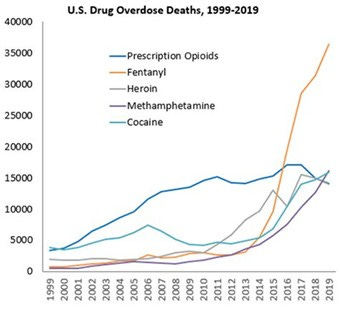
Substance abuse is not, primarily, a criminal conspiracy. The days of Prohibition taught us a lesson that we refuse to learn. Drug traffickers risk their lives delivering their product only because someone is willing to buy it. Blowing up a few speedboats merely makes a drug more valuable when it arrives. Addiction is a public health problem and needs to be addressed as such. The billions spent hunting producers would be better invested in addressing the problem here at home, with the people who are suffering the most. Banning drugs has clearly not been effective. It’s time to try regulating them instead, as we did with alcohol.
Immigration
America’s greatest asset has always been our people. Unless we are full-blooded indigenous, we are all descended from immigrants. As a whole, immigrants are responsible for America’s growing economic power and security; generating more patents, less crime, and doing jobs that most of us no longer want to do. They pick our fruit, build our houses, and care for our elderly. Without immigration, we would be poorer as a nation.
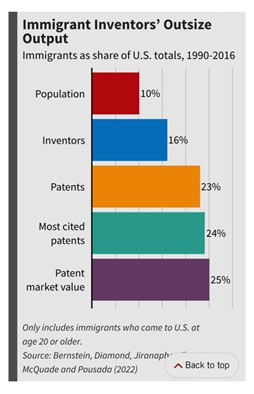
The term ‘migrant’ and ‘immigrant’ can be used somewhat interchangeably, but it is more helpful, for our analysis, to compare the immigrant (someone who wants to become a taxpaying citizen) with the migrant (someone who believes they have no realistic chance of becoming a legal American). By making citizenship such a long and arduous process, Congress has encouraged the illegal entry of migrants.
To reduce illegal entry and increase legal citizenship, Congress needs to increase manpower at immigration agencies, using modern tools to more quickly evaluate and approve or deny applicants. We need to revise ‘work and stay’ policies, shorten the process for naturalization, and revise our ridiculous quota system so that it is demand driven. Country of origin limits are nonsensical. It would be more rational to identify the skills that we need, and bring in people who can fill those jobs, along with their families. Few government policies are as out of date as our current immigration laws.
Our country has many more problems than these, but this group represents some that are largely generated by or own policies. They are not the failures on any single administration. They are the purview of Congress and can only be addressed by them.
In the new year, let’s resolve to encourage every member of Congress to propose and vote for fewer nonsensical things and more rational and targeted things. We need to face the fact that We Have Met the Enemy and He is Congress.
Reform Congress is a collaboration between Liz Terwilliger and Stephen Wahrhaftig.